Frequently Asked Questions
Frequently Asked Questions
We separated the continuation of some of the main questions that we received over the years of testing to facilitate and assist the Missionaries in questions by themes.
The host city for La Misión will once again be Villa la Angostura. Located in the south of the Neuquén province, it is one of the most beautiful cities in Patagonia—a picturesque mountain village nestled on the shores of Lake Nahuel Huapi. Surrounded by massive mountains and dense, lush forests, it is fully prepared to welcome thousands of tourists year-round, offering a wide variety of nature-related attractions. Beautiful landscapes, water activities, skiing, adventure sports, trekking, bird watching, peace, tranquility, and the absolute best in hotel accommodations and gastronomy.
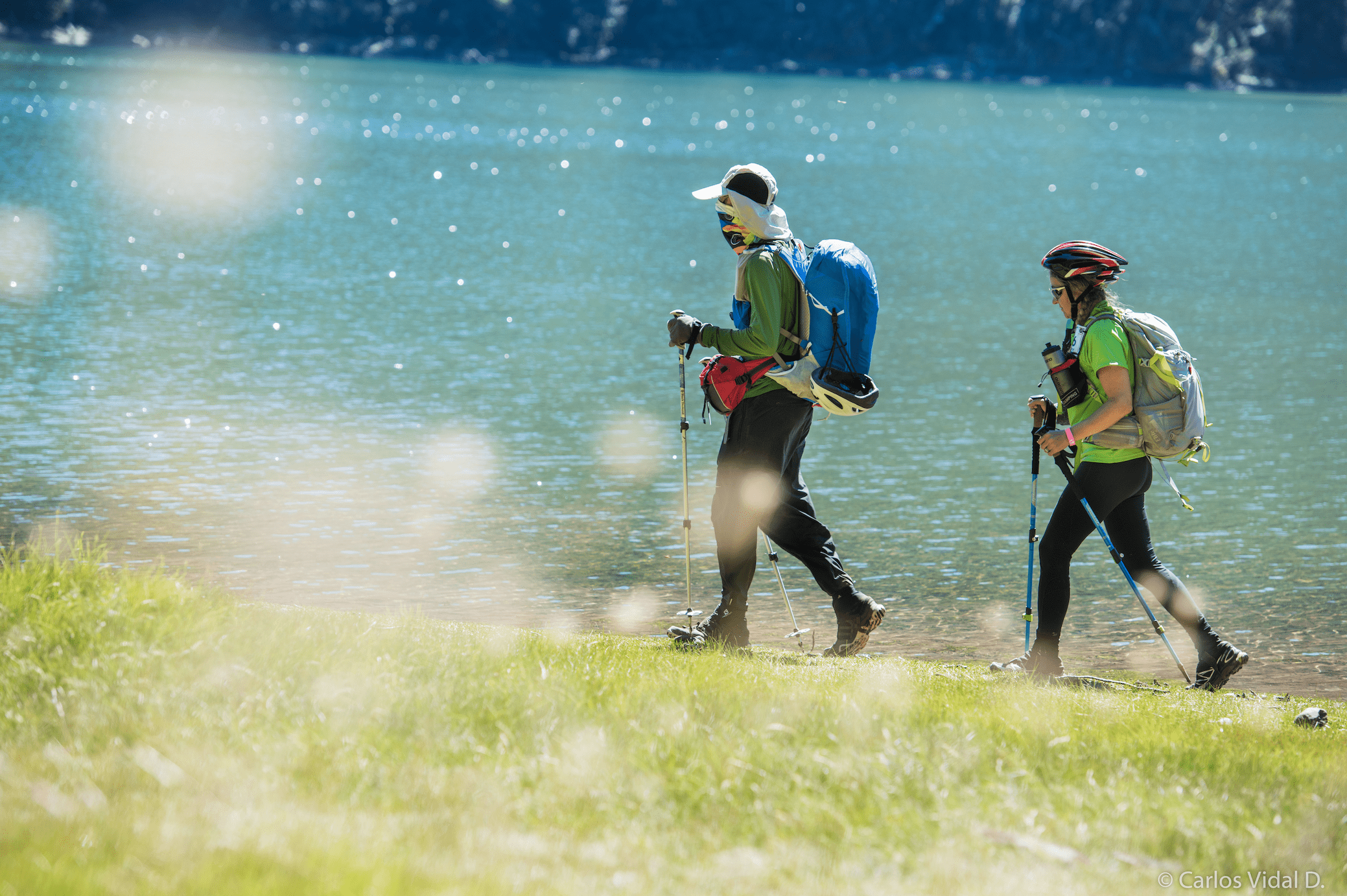
La Misión is a self-sufficiency trekking race that consists of completing a route of your choice, which can be 200 km, 160 km, 120 km, 80 km, or 40 km along trails through the forests and mountains of the Andes Mountains. There are no mandatory stops; therefore, everyone rests wherever and whenever they want.
Runners must complete the route in a 100% self-sufficient manner. This means they must carry all mandatory equipment and the food they will consume during the race on their backs. To stay on the correct course, runners must follow the paths that are marked and indicated in the roadbook, and use the Avenza Maps app for assistance. The approximate minimum average pace required to complete any of the routes is 2.5 km per hour or 24 minutes per km, which is more than enough time to complete any course.
Self-sufficiency means that each runner must be able to fend for themselves throughout the entire route. This implies:
- Carrying all mandatory equipment detailed in the rules (sleeping bag, waterproof jacket, first-aid kit, etc.).
- Carrying your own food for the entirety of the race (except for the permitted resupply in drop bags for long distances).
- Managing your own navigation using the map and App.
- Carrying your own waste to the finish line (it is strictly forbidden to leave trash in the mountains).
The organization only provides assistance in cases of severe medical emergency or rescue, but does not offer catering services, pre-assembled tents, or personal equipment transport during the course.
The routes are mostly along trails inside the forest and mountain paths, though sometimes participants will have to advance along dirt roads. The trails are very easy to follow and are also marked with red marks on trees and rocks.
Several streams and rivers are crossed via natural fords, and several different mountains between 1,800 and 2,000 meters high are climbed. It is an authentic, natural mountain course. Hydration is not an issue due to the large number of streams crossed, from which you can drink the water without any problems.
La Misión is a race heavily based on the spirit of long-distance mountain trekking or expedition hiking, where everyone must be 100% self-sufficient. In La Misión, unlike ultra trail, everyone must carry mandatory equipment that includes several items such as a waterproof jacket, bivy sack, and a sleeping bag, among other items.
On the contrary, in ultra trail, “minimalism” prevails—or some also associate the word “ultra” with “ultra-light”—meaning entering the mountains as light as possible, with minimal clothing and minimal equipment.
Another substantial difference from traditional ultra trail is the maximum time allowed to complete the course. In La Misión, you can complete the route by walking at a minimum average pace of 2.5 km per hour.
La Misión is a Trekking race, although anyone who wants to can jog as long as they are able. Most people walk during the entire route, and only the front-runners jog in certain sectors, such as on downhills and flat terrain.
The maximum time to complete the courses is very generous, allowing a person walking normally and resting about 6 to 8 hours per day to reach the finish line. Across all distances, the minimum average to reach the finish line is 2.5 km per hour or 24 minutes per km, which is more than enough time to complete the route.
It is a proven fact that trekking is the healthiest physical activity for human beings.
The race is designed for the following timeframes:
- 200 km: 38 hours for the front-runners and 80 hours for the last finishers.
- 160 km: 28 hours for the front-runners and 72 hours for the last finishers.
- 120 km: 18 hours for the front-runners and 54 hours for the last finishers.
- 80 km: 11 hours for the front-runners and 36 hours for the last finishers.
- 60 km: 8 hours for the front-runners and 27 hours for the last finishers.
- 40 km: 4 hours for the front-runners and 18 hours for the last finishers.
General Categories
- Individual Men
- Individual Women
Prizes will be awarded to the top three of each category.
In addition to the General Ranking, an Age Group Ranking will be drafted and published on the website according to the following age ranges:
- Senior A: from 18 to 29 years old
- Senior B: from 30 to 39 years old
- Veterans A: from 40 to 49 years old
- Veterans B: from 50 to 59 years old
- Master: from 60 years old and above
You must visit the website lamisionrace.com and go to the Registrations section.
There, you must create a username (ID/DNI) and password, fill out the form (make sure to type your email address correctly), select your distance, pay the USD 10 fee for the form, and click submit.
The organization will reply to your email shortly with the next steps to follow. There are several promotions throughout the year; if you take advantage of them exactly as specified in the email you receive, you can secure a cheaper registration price.
Registration values for the first promotion are valid until June 10.
(From June 11 onward, all prices increase by USD 30)
- Registration Form – Value USD 10: These USD 10 are the cost of processing the registration form and act as a filter to prevent people who will not run from submitting forms just because it is free. Those USD 10 are not included in the registration values listed below.
- LM 40 km – USD 160
- LM 60 km – USD 190
- LM 80 km – USD 210
- LM 120 km – USD 260
- LM 160 km – USD 310
- LM 200 km – USD 360
Across all distances, registration includes:
- The most valuable asset we have: Time. Sufficient time to be able to reach the finish line.
- A genuine hiking route through forests and mountains.
- Assistance and rescue in the event of a severe emergency.
- A drop bag for resupply for the 120, 160, and 200 km distances.
- The option to switch from a longer distance to a shorter distance in the middle of the race.
- Personal accident insurance.
- Race bib number.
- Official La Misión design T-shirt.
- Official La Misión design neck gaiter.
- Official La Misión design headband.
- A pair of official La Misión trekking socks.
- “Mission Accomplished” Finisher Medal.
- Snack, beverage, and burger at the finish line.
Yes. Registering for a longer distance includes the right to switch to a shorter distance in the middle of the race and, depending on the case, rank in the completed distance according to the position in which you arrive.
This is a fair regulation and does not provide any physical advantage to the runner who changes distance, as they exert the same effort and cover the same route as everyone else at the same time.
- Those who sign up for 200 km are simultaneously entered into the 160, 120, 80, 60, and 40 km lists.
- Those who sign up for 160 km are simultaneously entered into the 120, 80, 60, and 40 km lists.
- Those who sign up for 120 km are simultaneously entered into the 80, 60, and 40 km lists.
- Those who sign up for 80 km are simultaneously entered into the 60 and 40 km lists.
- Those who sign up for 60 km are simultaneously entered into the 40 km list.
- Those who sign up for 40 km are only entered into the 40 km list.
You must be over 18 years old. The average age of La Misión participants is 45 years old.
Because La Misión is a true mountain race that takes place in remote areas where there is no vehicular access or nearby roads, and runners can be out on the course for up to four days. It is not comparable to other races where the routes always run alongside roads or towns.
That is why a mandatory kit of equipment is required to participate in La Misión. However, it is very important to consider that this is a vital minimum equipment requirement that each runner must adapt based on their own capabilities.
It is important—and this is why the organization recommends it—not to choose the lightest garments just to save a few grams, but rather to choose gear that truly provides good mountain protection against cold, wind, rain, and snow, thereby ensuring better safety and performance.
These are zippered bags provided by the organization intended for placing food and light spare clothing. The capacity of the bags is 30 liters.
You must fill the bags with whatever you deem necessary and hand them over to the organization before the start. All participants in the La Misión 200 km, 160 km, and 120 km distances will receive a zippered bag with the La Misión logo during check-in.
You will find this bag at km 80, and those in the 200 km distance will find it again at approximately km 150. Bags with leftover items will be handed back to you at the finish line.
The goal of these spare gear bags is to lighten the runners’ backpacks regarding food, allowing everyone to carry the best mandatory safety equipment, which must be carried in the backpack at all times.
The official and mandatory App to view the route track is Avenza Maps. You must download this app to your mobile phone and then purchase the La Misión 1/50000 map inside the app for a one-time fee of USD 5.
The Avenza Maps App functions as an autonomous GPS, meaning it does not require an internet connection or cellular data. When you open the La Misión map in the middle of the race anywhere along the route, the map will appear showing all the existing trails in the area along with a blue dot indicating the exact location where you are at that very moment.
Nothing; the race is not canceled due to bad weather and takes place regardless. This is precisely why all mandatory safety equipment and mountain apparel are required—for when it rains or gets very cold. This special clothing was invented and manufactured specifically to withstand rain, snow, and cold.
What can happen is that a specific sector may be neutralized for a few hours or the original route modified due to an extreme reason. E.g.: a stream flooding or extreme whiteout conditions, both of which are very unlikely factors in February.
In the event that you abandon the race and do not have any severe injury preventing you from walking, you must make your own way by your own means to an accessible location, such as a road, where you can be picked up or self-evacuate.
This is because, as this is a race in a wild environment amidst massive mountains with no internal roads, it is impossible to effect vehicular rescues. Therefore, everyone must look after themselves, and we use the terms self-evacuation or self-rescue—meaning the runner must do their part to aid in their own evacuation.
Cutoff times begin starting from km 50 and will be governed by an average marching pace of 2.5 km per hour. Anyone moving slower than this average after km 50 will not be allowed to continue because they will no longer have enough time to reach the finish line.