RULES
Rules and Regulations
A. The Race
Distances
La Misión is a self-sufficiency mountain trail or trekking race held in Villa la Angostura, where runners must complete a chosen route of either 40k, 60k, 80k, 120k, 160k, or 200k, within a pre-established maximum time for each distance.
Self-Sufficiency
La Misión is a race held under the concept of total self-sufficiency. This means runners must carry all their equipment and food in their backpacks throughout the entire route. Only participants in the 120k, 160k, and 200k distances can resupply at the Villa Traful checkpoint (km 80), where they will find their own drop bag and can also buy food at any local store in the village.
The 200 km distance will additionally have a drop bag station at km 150 Eco Huertas.
The 40k, 60k, and 80k distances will not have a drop bag (they do not pass through Villa Traful).
Trekking
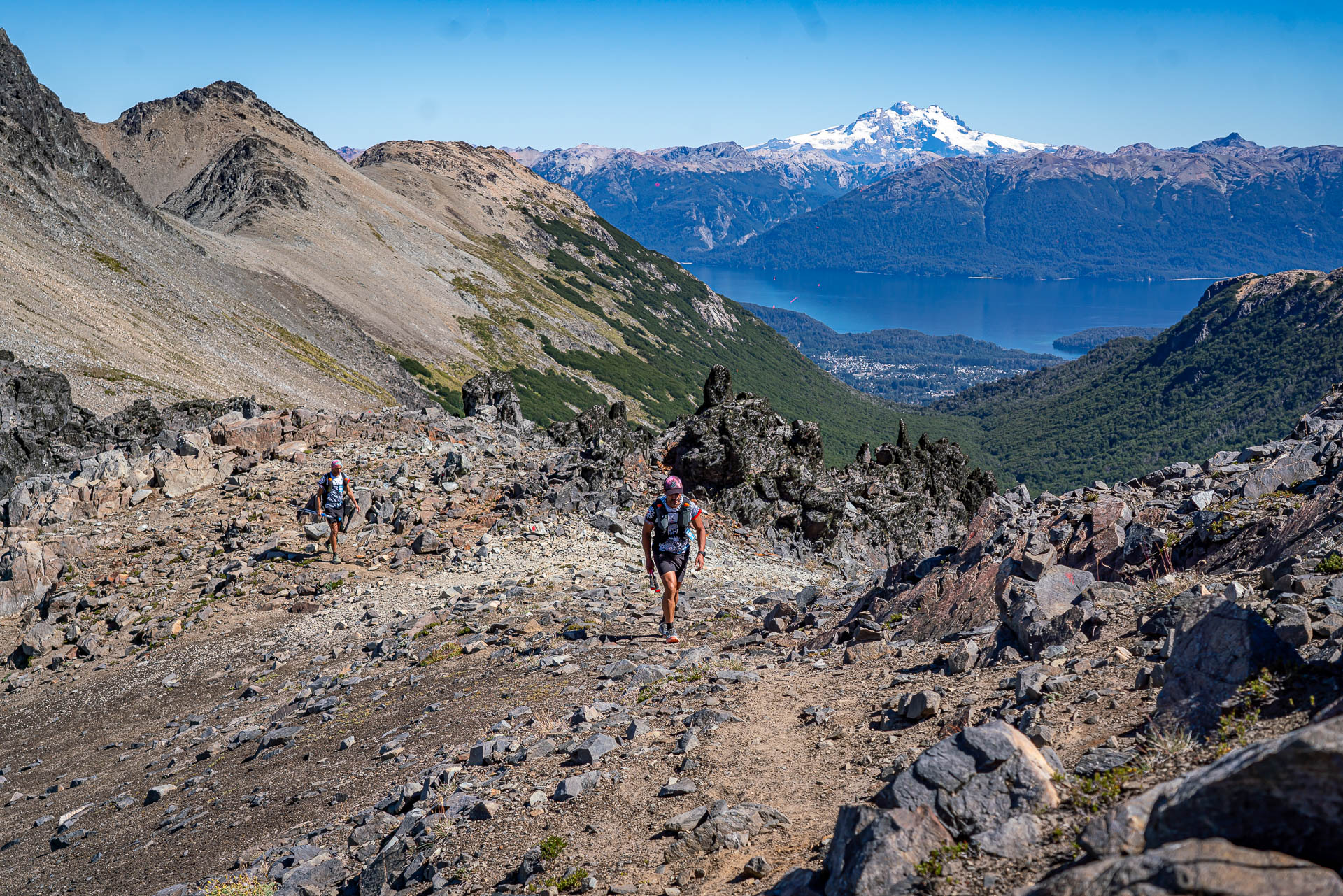
La Misión is a race along mountain trails that are very clear and easy to identify and follow on the terrain. Therefore, in La Misión, we do not mark trails with plastic ribbons; instead, we keep the paths clear and use the typical signage of the area, which consists of red marks on trees and rocks. In La Misión, the basic concept of trekking applies: you must follow the path you are on.
Roadbook
For greater runner safety and so each participant can verify they are on the correct trail, the organization publishes a “roadbook” with references to follow on the website under the description of each route. Combined with the Avenza Maps app, runners can self-guide along their course, knowing where they are in real-time and which path to take at trail forks, junctions, roads, etc.
The Avenza Maps app is a mandatory tool that everyone must have on their cell phone with the La Misión 1/50000 map. It is a very intuitive and easy-to-use app that can be downloaded to any phone. It functions as an autonomous GPS, meaning it does not require an internet connection or cellular data. Those who already have it downloaded just need to check for any updates, which are free.
A.1 Route Characteristics
The route of La Misión across all distances follows wild mountain trails that are very easy to follow, as they are well-marked and highly visible on the ground. Throughout the course, runners will sporadically encounter various obstacles such as fallen logs, stream crossings, wetlands, scree fields, etc. All these obstacles are easy to overcome, and runners only need to be careful when crossing fallen trees.
The trails are marked with red marks on trees and rocks, as well as reflective tape (in both directions), making it virtually impossible to stray from the path. Along the route, the organization deploys rescue patrollers who are generally located at key points like junctions, summits, or high-risk sites.
To navigate safely along the correct route, runners must follow the trails and self-guide using the roadbook and the Avenza Maps app. Throughout the entire course, natural drinking water will be constantly available from streams crossing the trail. At no point will runners travel cross-country off-trail.
B. Distances / Routes
The routes along with their roadbook, elevation profiles, references, average times, and further information are available in the Routes Menu.
On the La Misión 1/50000 map within the Avenza Maps app, all routes are shown on the same map. To figure out the specific route for your distance, you only need to connect the references from the roadbook, which are listed in chronological order of passage, and you will see your course. We recommend studying the route on the map in advance, combining it with the elevation profile.
- La Misión 200 Km
Extraordinary distance with a cumulative elevation gain of over 10,000 meters. Maximum time: 80 hours (2.6 km/h). Participants will have 2 drop bags: at Villa Traful (km 80) and Eco Huertas (km 150). - La Misión 160 Km
Traditional distance with a cumulative elevation gain of over 8,000 meters. Maximum time: 72 hours (2.2 km/h). One drop bag at Villa Traful (km 80). - La Misión 120K
Same route as the 160 km but diverting at Arroyo Ujenco (km 105). Maximum time: 54 hours (2.2 km/h). Drop bag at Villa Traful. - La Misión 80K
Same route but diverting at km 40 towards Bahía Manzano. Maximum time: 36 hours (2.2 km/h). No drop bag. - La Misión 60K
Intermediate distance. Diverting at km 40 towards Bahía Manzano and at km 50 (Corral Redondo) towards the finish line. Maximum time: 27 hours (2.2 km/h). No drop bag. - La Misión 40K
Same initial route but diverting at km 20 (Arroyo Voruco crossing). Maximum time: 18 hours (2.2 km/h). No drop bag.
B.5 Distance Changes
Registration for a longer distance includes the right to switch to a shorter distance in the middle of the race and, depending on the case, rank in the completed distance according to the position in which you arrive.
- Registration for 200 km includes the right to switch to 160, 120, 80, 60, or 40 km.
- Registration for 160 km includes the right to switch to 120, 80, 60, or 40 km.
- Registration for 120 km includes the right to switch to 80, 60, or 40 km.
- Registration for 80 km includes the right to switch to 60 or 40 km.
- Registration for 60 km includes the right to switch to 40 km.
This is a fair regulation and does not provide any physical or other type of advantage to the runner who changes distance, as they exert the same effort and cover the same route as everyone else at the same time, since all distances start together at the exact same moment.
This way, 40 km runners know before the start that they are competing in their distance against everyone from the other distances. The 60 km runners know they are also competing against those from the 80, 120, 160, and 200 km categories, and so on.
B.6 Cutoff Times
La Misión is a mountain trekking race that includes the most precious thing we have in its kit: time. Sufficient time to complete the course trekking at a minimum average pace of 2.2 km per hour or 27 minutes per km. This is a very generous time window.
This time calculation will be used to establish cutoff times mainly for the 120, 160, and 200 km distances, especially at the entry checkpoints to Arroyo Ragintuco and Mallín de las Nieblas.
If a person passes through these stations at a pace slower than the 2.2 km/h average, it indicates they will cover the next kilometers even slower; therefore, by common sense, they will not be able to reach the finish line on time at that pace. That person will not be allowed to continue the race.
Clarification: The 2.2 km per hour average is a pace achieved at the end of the race, not a continuous walking pace. If at the beginning of the race you start walking at 2.2 km/h, you should know it will be very difficult to reach the finish line, as you will likely get slower over time.
C. Concepts to Bear in Mind
To participate in La Misión in any of its distances, participants must be fully aware of the following concepts:
- C.1 Each participant must be fully aware of the scope and characteristics of each distance and be physically and mentally prepared for it.
- C.2 Each participant must have sufficient capacity to act autonomously in the mountains and across any part of the route, allowing them to solve, without assistance from the organization, the foreseeable problems encountered in this type of event—especially those related to weather conditions, which can be very difficult in the mountains, particularly at night with wind, cold, rain, or snow.
- C.3 Each participant must know how to manage, even while alone and without organizational help, any physical or mental problems resulting from fatigue or extreme weather conditions. Example: Extreme fatigue, sleep deprivation, dehydration, blister treatment, digestive issues, muscle or joint pain, minor wounds, etc.
- C.4 Each participant must be fully aware that the organization’s role is not to help a participant solve their own personal issues, such as those related to weather protection.
- C.5 Each participant must be fully aware that for this high-mountain activity, personal safety essentially depends on their own ability to move through the mountainous terrain where the race takes place.
- C.6 Each participant must know how to use the mandatory Avenza Maps app with the La Misión 1/50000 Map.
D. Self-Sufficiency
La Misión is governed by the principle of an individual self-sufficiency race. That is, each participant must have the ability to manage their own autonomy between the start and the finish line, both for navigating the correct course following the roadbook, feeding themselves with their own food, and carrying the appropriate clothing for their own safety and personal care. This ensures they can face and resolve, without help from the organization, all foreseeable problems in a mountain environment like the one where the race is held.
To achieve this, each participant must plan and carry the necessary food, the appropriate mandatory equipment, a first-aid kit, and any extra material they deem necessary, based on their own estimated time to complete the race. This includes the food that each participant will place in their resupply drop bags for the 120, 160, and 200km distances.
E. Categories
- Individual Men
- Individual Women
E.1. Prizes will be awarded to the top three of each category in the General Classification.
E.2 There will be no cash prizes.
E.3. Age Sub-categories:
- A) 18 to 29 years old
- B) 30 to 39 years old
- C) 40 to 49 years old
- D) 50 to 59 years old
- E) 60 to 69 years old
- F) over 70 years old
E.4. The classification for the age Sub-Categories will be published on the website, but they will not receive special prizes.
F. During the Race
- F.1 The organization will provide each 120 and 160 km participant with one bag for resupply at the km 80 Villa Traful checkpoint.
- F.2 The organization will provide each 200 km participant with a resupply bag that will be transported to the km 80 Villa Traful checkpoint and later to km 150 Eco Huertas.
- F.3 Participants in the 40, 60, and 80 km distances will not receive a resupply drop bag.
- F.4 The organization will publish a roadbook for each distance under the Routes section of the website, which, combined with the La Misión 1/50000 map on the Avenza Maps App, will serve the runner to check their position.
- F.5 All distances will start the race at the exact same time.
- F.6 Each participant must be fully self-sufficient between the start and the finish line.
- F.7 The organization does not guarantee the provision of any indoor areas for resting.
- F.8 There will be cutoff schedules at some advance checkpoints where extremely delayed runners or those with physical issues will not be allowed to continue. The slowest allowed average pace of 2.2 km/h or 27 minutes/km will be taken into account.
- F.9 Runners must pass through all checkpoints mandatory and chronologically.
- F.10 Runners may not receive planned external assistance during the route. Receiving assistance from family or friends is forbidden. If a participant is caught accepting this help, they will be disqualified.
- F.11 There will be no mandatory stops or dead times; each runner can manage their own pace, stops, and rests anywhere along the route.
- F.12 At the end of the race, there will be a General Ranking for Women and Men, as well as an age-group ranking.
- F.13 It will not be permitted for two or more runners to cross the finish line together. If this happens, they cannot share the same position in the ranking.
- F.14 If a runner abandons the race, they must self-evacuate, make their own way to the nearest road, manage their return to VLA, and notify the organization.
- F.15 The organization will only evacuate a runner from the route if they are in a severe medical condition that prevents them from walking. Otherwise, each runner must self-evacuate.
G. Mandatory Equipment
To participate in La Misión, a mandatory equipment kit is required. It is very important to consider that this is a vital minimum equipment requirement that each runner must adapt based on their own capabilities. We recommend choosing gear that truly provides good mountain protection against cold, wind, rain, and snow, thereby ensuring better safety and performance.
- G.1 Each runner must be aware that safety regarding weather factors depends on the equipment and warm clothing they carry with them.
- G.2 They must carry this equipment throughout the entire race unless the Race Director decides to make an exception.
- G.3 There will be equipment checks during the race. If a runner is caught without any item of their mandatory equipment, they will be disqualified.
- G.4 The website Menu lists the mandatory Equipment, and the Suggested (but non-mandatory) Equipment is listed at the end.
- G.5 If the weather forecast for the race days is very favorable, the Race Director may decide that certain equipment items are not mandatory for some distances.
- G.6 Just because a piece of clothing or equipment is not mandatory does not mean it is forbidden to carry it. E.g., a sleeping bag is not mandatory, but you can carry it; trekking poles are not mandatory either, but you can bring them, etc.
H. Rights of the Race Director and the Organization
- H.1. The Race Director is the Judge and ultimate authority during the race.
- H.2. The Race Director reserves the right to make changes to the original race route for safety reasons related to weather or other circumstances without prior notice.
- H.3. The Race Director has the right to neutralize, shorten, or suspend the race for safety reasons related to extreme weather factors, without this giving runners any right to claim.
- H.4. In case of highly unfavorable weather conditions (heavy rain, snow at high altitudes, thunderstorms, winds exceeding 100 km/h), the start may be delayed by a few hours, but if it does not improve, the race may be suspended until further notice.
- H.5. The Race Director can compel a runner to abandon the race if they are extremely delayed or showing obvious physical problems.
- H.6. The Race Director reserves the right to disqualify any participant from the competition who fails to comply with the rules.
- H.7. The Race Director may disqualify a runner even after the race has finished, upon becoming aware of any violation of the rules.
I. Registrations
- I.1 Registrations open in May 2026 via the website.
- I.2 To register, you must access the Registration form. If you already have a username and password from last year, you must log in with your ID (DNI) and password. If you have never registered, you must do so just once with a username (ID/DNI) and password. Once inside the Registration site, fill out the form correctly, select the race, and proceed with a USD 10 payment to submit the form. Afterwards, you will receive an email with instructions to finalize the registration.
- I.3 The USD 10 paid with the Registration form acts as a filter, is the same for all distances, and is not part of the total registration fee. This payment is non-refundable.
- I.4 Everything stated in the response email regarding registration, payment, and refunds is part of these official rules.
- I.5 By paying the registration fee, each participant assumes the personal risk that any sudden problem may prevent them from participating in the race, thereby losing the deposit or the full registration fee. E.g., last-minute health issues, injuries, family emergencies, work issues, travel problems.
- I.6 The registration, either in whole or in part, is non-transferable to another person.
- I.7 If a person who has paid the registration in full or in part notifies before December 10 that they cannot participate, the amount paid will be credited toward the next race (except for the initial USD 10).
- I.8 If a person who paid the registration in full or in part notifies after December 10 that they cannot participate or fails to show up for the race, they forfeit the registration fee.
- I.9 After December 20, it will not be possible to change registration from a longer distance to a shorter distance. In this case, the person must pay the registration fee for the longer distance originally chosen, but they will be allowed to switch to the shorter distance during the race at the checkpoint where the distances split.
- I.10 By paying the deposit, you acknowledge that you have read and therefore accept everything outlined in the Rules.
- I.11 The registration price is structured as follows: USD 50 represents the registration value, and the remainder covers race services, including access to event logistics, kit items, rescue and first-aid insurance, and general safety.
- I.12 The fee for each Registration is listed in the Info menu.
- I.13 The registration fee can be paid in installments.
J. Individual Responsibilities During the Race
- J.1 Each participant shall be responsible for their own performance in the race and must judge for themselves whether or not they can continue.
- J.2 Each participant must self-guide during the race by reading the roadbook and utilizing the La Misión 1/50000 map on the Avenza Maps app.
- J.3 Each participant must carry all their mandatory equipment.
- J.4 Before starting the race, each participant must be aware that in the event of severe weather conditions such as rain, snow, wind, and cold, they must face that situation by their own means and with their own equipment.
- J.5 Any participant who sees another in an emergency must provide the necessary assistance and ensure the organization is notified.
- J.6 Each participant must sign an Informed Consent / Commitment of Honor, acknowledging that they are physically fit to undertake this test, that they have read these Rules, and that they are aware of what they will face during the race. Without signing this document, they will not be allowed to start the race.
- J.7 To participate in La Misión, participants must be over 18 years old.
K. Safety and Emergencies
- K.1 Civil Liability Insurance: The organizer has contracted civil liability insurance for the duration of the event. This insurance covers the risks of the organization, its contractors, and the participants.
- K.2 Individual Accident Insurance: The organization includes basic insurance.
- K.3 In case of an emergency during the race, participants must notify the nearest patroller or another runner so they can alert the nearest patroller.
- K.4 Every participant must provide assistance to anyone else who needs it due to an emergency.
- K.5 If a participant decides to abandon the race for reasons that are not severe to their health, they must make their own way to the nearest road, manage their return to VLA, and notify the organization.
L. Disqualifications
- L.1 Making fires during the race is strictly forbidden.
- L.2 If a participant fails to pass through a Checkpoint or deliberately leaves the trail to take a shortcut, they will be disqualified.
- L.3 If a participant is missing any item of Mandatory Equipment during the race, they will be disqualified.
- L.4 If a participant displays unsportsmanlike or aggressive attitudes toward other runners, or destructive behavior toward nature, they will be disqualified. E.g., insults or aggression between runners or against any staff member, or destructive actions against nature.
- L.5 If a participant uses any means of transportation, they will be disqualified.
- L.6 If a participant advances through a prohibited zone previously specified by the organization, they will be disqualified.
- L.7 If a participant accepts and receives assistance from family or friends, they will be disqualified. E.g., assistance from a relative or friend waiting on a road with food or water, entering a CAMP, or being driven to a hotel.
- L.8 A participant may be penalized or disqualified even after the competition has concluded, should the race director become aware of any violation of these Rules.